Published May 12, 2026 · by Anže Skodlar
Employment Contract – What It Must Contain
An overview of the mandatory elements of an employment contract under Article 31 of the Slovenian Employment Relationships Act (ZDR-1) and how to avoid the most common drafting mistakes.
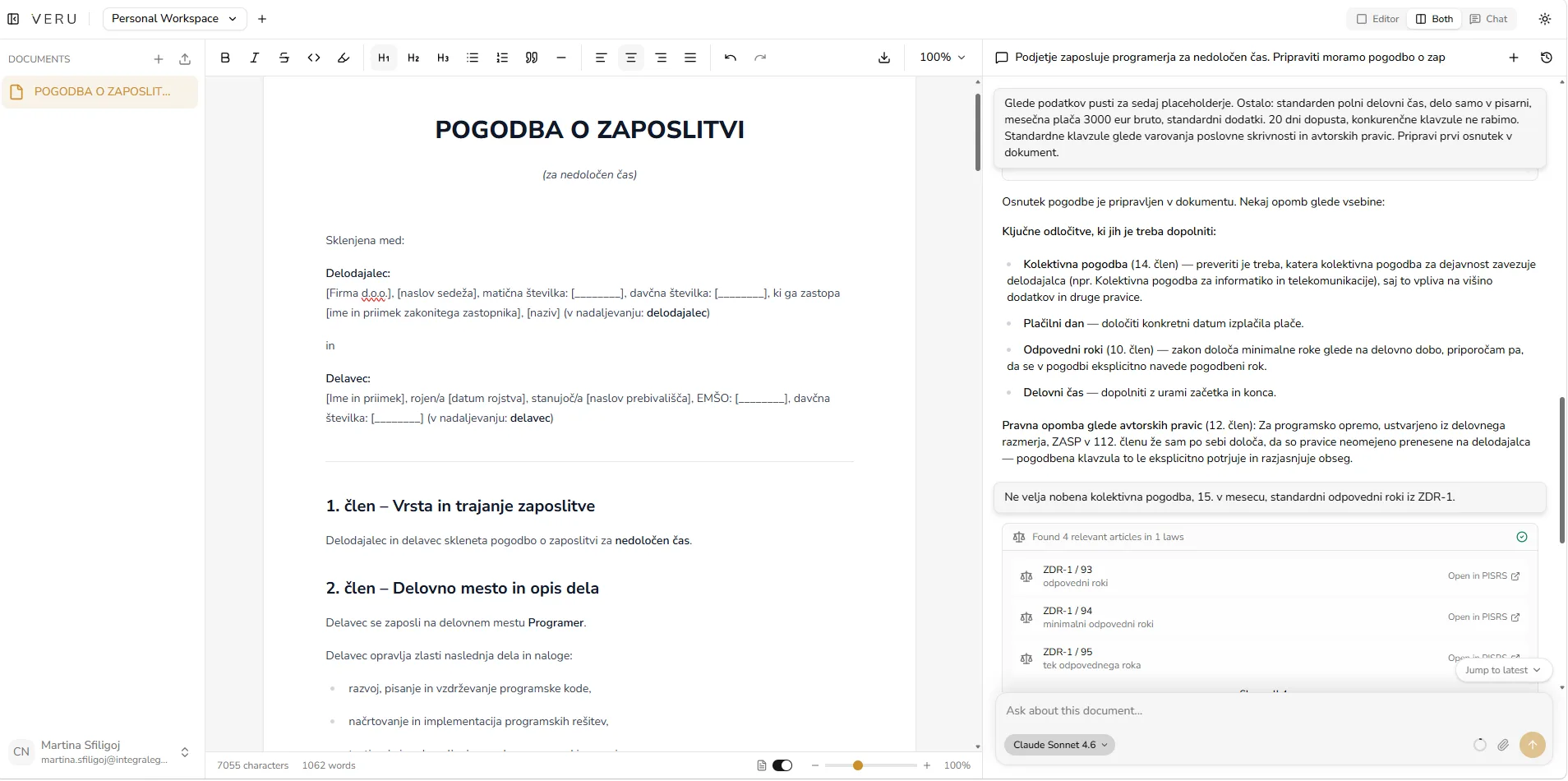
An employment contract is one of the most frequently used contracts in business practice, yet it is often drafted incompletely or incorrectly. An incomplete or improperly drafted contract can lead to employment disputes or situations in which statutory provisions apply directly in place of the agreed terms — provisions that are frequently formulated in favour of the employee. To avoid this, it is essential to be familiar with its mandatory elements.
The content of an employment contract is regulated in detail under Slovenian law by the Employment Relationships Act (Zakon o delovnih razmerjih - ZDR-1). In accordance with Article 31 of ZDR-1, every employment contract must contain the following elements:
Identification of the Parties and Commencement of Work
- Details of the contracting parties: Full particulars of the employer and the employee, including their address or registered seat.
- Date of commencement of work: The exact date on which the employee begins performing their duties.
Description and Place of Work
- Position title or type of work: A brief description of the tasks the employee will perform. It is important that the required level and field of education, as well as any other conditions specified in the job classification system, correspond to the work in question.
- Place of work: Specification of the exact location. If the place of work is not expressly stated, the employee is deemed to perform work at the employer's registered seat.
Duration and Working Hours
- Term of the employment contract: An indication of whether the contract is a fixed-term or permanent (open-ended) contract. In the case of a fixed-term contract, the reason for its conclusion and the manner of taking annual leave must be stated.
- Scope of working hours: A provision specifying whether the arrangement is full-time or part-time.
- Daily or weekly working hours: Specification of the number of hours and the distribution of working time.
Remuneration and Supplements
- Basic salary: The amount in euros to which the employee is entitled for performing work under the employment contract, as well as any other payments.
- Other components of remuneration: Provisions concerning supplements, the pay period, the pay date, and the method of salary payment.
Leave, Notice Periods, and Training
- Annual leave: A statement of the duration of leave or, at minimum, the method by which it is determined.
- Notice periods: The length of the period that both parties must observe in the event of termination of the contract.
- Training: An indication of the training to be provided by the employer to the employee.
General Acts and Collective Agreements
- Reference to collective agreements: The collective agreements binding on the employer must be stated, as well as any general acts that set out the working conditions in greater detail.
The second paragraph of Article 31 of ZDR-1 permits the parties, with respect to working hours, remuneration, leave, notice periods, and training, to refer directly to applicable legislation, collective agreements, or the employer's general acts rather than setting out the relevant provisions in detail within the contract itself.
In addition to these general requirements, contracts relating to specific circumstances — such as work abroad under Article 209 of ZDR-1 — must include further specific elements, such as the duration of work abroad, the currency of payment, and the conditions for return to the home country.
Need support with legal work?
An employment contract is the foundation of every employment relationship. A well-drafted contract protects both the employer and the employee and prevents disputes before they arise.
Veru Legal AI helps you prepare contracts and other legal documents quickly and reliably — always supported by case law and applicable legislation. Traceable, transparent, and verifiable.