Published June 24, 2026 · by Anže Skodlar
Internal Acts: Which Ones Employers Must Have
Internal acts are not merely a bureaucratic formality — they are a legal obligation for employers. Here is an overview of which internal acts are mandatory under Slovenian law and which are strongly recommended.
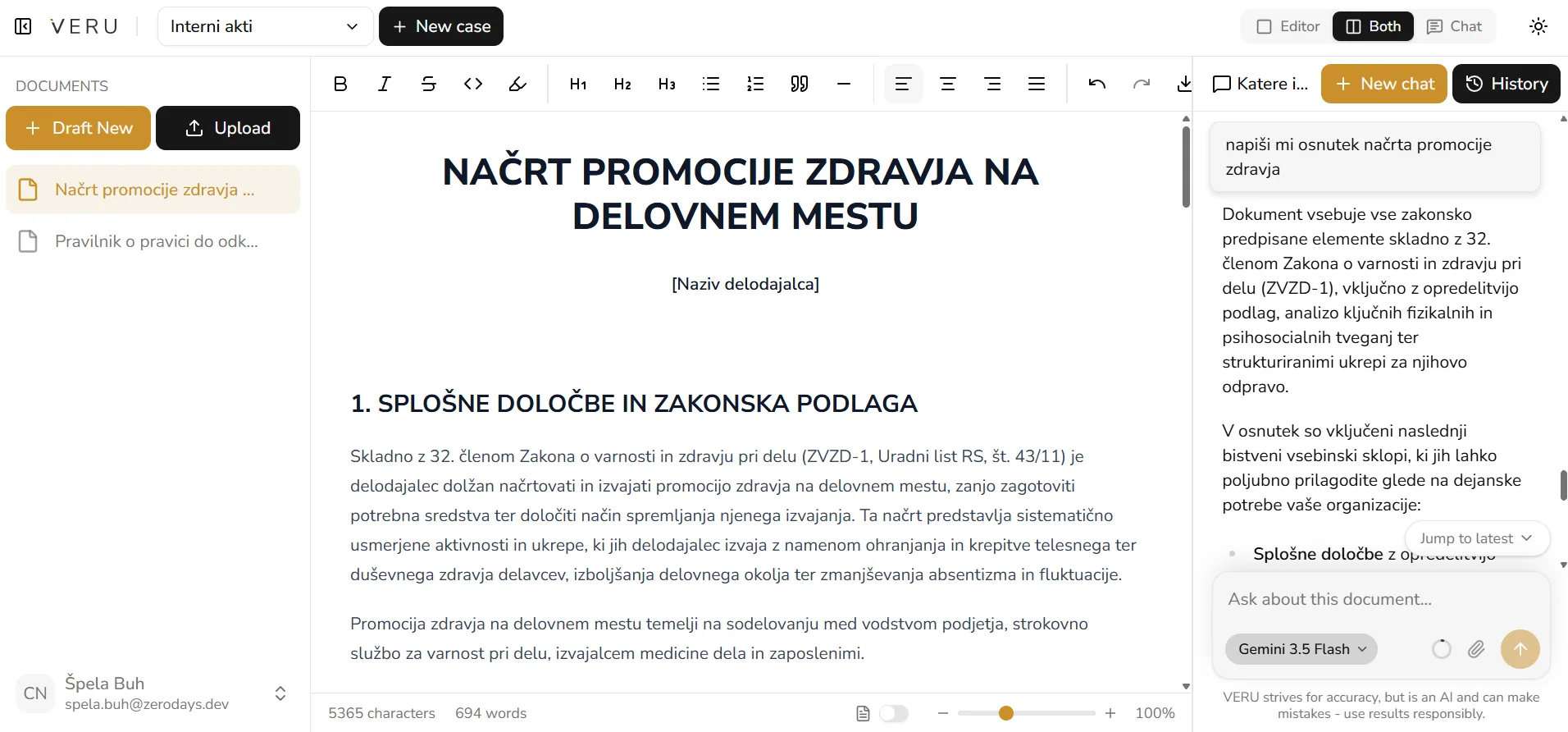
Internal acts are not merely a bureaucratic formality — for employers, they represent a legal obligation, the breach of which is subject to substantial fines.
Under Slovenian law, certain internal acts are mandatory for employers by statute, while others are recommended for regulating specific processes. The obligation to adopt internal acts also depends on the size of the company (the so-called "small employer" threshold, applicable to employers with 10 or fewer employees).
Here is a summary of the key internal acts that an employer must have in place.
General mandatory acts
- Job Classification System Act (Akt o sistemizaciji delovnih mest): Mandatory for all employers, with the exception of small employers (10 or fewer employees). It must set out the conditions for performing work in each post or for each type of work (Article 22 of ZDR-1).
- Safety Statement with Risk Assessment (Izjava o varnosti z oceno tveganja): One of the most important documents in the field of occupational health and safety. The employer must carry out a written assessment of the risks to which employees are exposed and define measures to reduce them (Article 17 of ZVZD-1).
- Policy on the Prevention of Mobbing, Harassment, and Sexual Harassment in the Workplace (Pravilnik o preprečevanju trpinčenja, nadlegovanja in spolnega nadlegovanja na delovnem mestu): The employer is obliged to adopt appropriate measures to protect employees against mobbing and harassment and to notify employees thereof in writing (Article 47 of ZDR-1 and Article 24 of ZVZD-1). Such measures are typically adopted in the form of a policy.
- Right to Disconnect Policy (Pravilnik o pravici do odklopa): Since November 2024, all employers must adopt measures ensuring employees the right to disconnect (the right not to be available to the employer during rest hours). The measures are determined by collective agreement or general act, typically in the form of a policy (Article 142a of ZDR-1).
- Workplace Health Promotion Plan (Načrt promocije zdravja na delovnem mestu): In accordance with the guidelines of the Ministry of Health, the employer must plan health promotion activities, allocate resources for their implementation, and establish a method for monitoring their execution (Article 32 of ZVZD-1).
Mandatory records
Although the law does not strictly require a formal written policy in every case, the employer must ensure that records are maintained in accordance with the Act on Records in the Field of Labour and Social Security (Zakon o evidencah na področju dela in socialne varnosti – ZEPDSV):
- Record of employed workers.
- Record of working time utilisation (including arrival time, departure time, and breaks).
- Record of labour costs.
- Record of forms of resolution of collective labour disputes with the employer.
Conditionally mandatory or strongly recommended acts
- Working Hours Policy (Pravilnik o delovnem času): Recommended where working hours are irregular or where the employer wishes to establish specific rules regarding time recording, on-call duties, or overtime work.
- Remuneration and Rewards Policy (Pravilnik o plačah in nagrajevanju): Mandatory where the details of remuneration (e.g. variable pay components, supplements) are not already defined in a collective agreement or individual employment contracts.
- Disciplinary Liability Policy (Pravilnik o disciplinski odgovornosti): Where the employer wishes to impose disciplinary sanctions, the violations and the procedure must be defined in advance in a general act or collective agreement.
- Information Technology Use Policy (Akt o uporabi informacijske tehnologije): Recommended for establishing rules on the use of company software, electronic mail, and the internet.
- Personal Data Protection Policy (Pravilnik o varstvu osebnih podatkov): In accordance with the General Data Protection Regulation (GDPR) and ZVOP-2, the company must document the processes for handling employees' personal data.
Procedure for adopting general acts
It is important to emphasise that, when adopting general acts that define the organisation of work or the obligations of employees, the employer must follow the procedure set out in Article 10 of ZDR-1:
- The draft act must be submitted to the trade union for its opinion (where one exists).
- If there is no trade union, the employer must consult the works council or employee representative.
- If neither exists, the employer must inform employees of the content in the customary manner (e.g. notice board, email) prior to adoption.
Sanctions for violations
Non-compliance with these obligations (in particular with regard to occupational health and safety, mobbing, and the right to disconnect) is subject, under Article 217a of ZDR-1 and Article 76 of ZVZD-1, to substantial fines, which for legal entities may amount to several thousand euros.
Wondering whether your policies are compliant?
A set of internal acts that is incomplete or out of step with current legislation does not protect you — it can expose you to fines at the very moment compliance matters most.
Veru Legal AI helps you verify compliance and prepare or optimise legal documents — quickly and reliably, always supported by case law and applicable legislation. Traceable, transparent, and verifiable.