Published September 9, 2026 · by Anže Skodlar
AI myths in law: how much of what you hear is actually true?
Six concerns legal professionals most often raise about artificial intelligence. For each one, what's true in it and where the myth ends.
Lawyers talk a lot about artificial intelligence in law, but far fewer actually try it than talk about it. The reasons are almost always the same, repeated in the same handful of sentences:
"AI makes up rulings," "AI doesn't know Slovenian law," "I'm not allowed to upload case files to AI," "I'll have to check everything afterward anyway."
Each of these concerns is valid and carries a grain of truth. Still, it's worth showing where that truth ends, because most of these claims actually describe a general-purpose chatbot, not AI built specifically for legal work. It's worth knowing the difference before writing the tools off altogether.
What follows are six myths that lawyers most often hear in connection with artificial intelligence. For each one, we look at what's true in it and where the myth ends, and at the end, what a tool built for the legal context actually solves among all of this.
Myth 1: "AI makes up rulings."
What's true: A general-purpose language model (LLM) is designed to generate the most probable continuation of text. If it doesn't have the actual ruling in its memory, it will compose one that sounds plausible — with the correctly formatted case number, a convincing summary, and exactly the legal thesis the user wanted to hear. In some countries, lawyers have already been sanctioned for filings containing non-existent rulings.
Where the myth ends: With the tool's architecture. A model that answers from its own memory, and an AI system that first searches actual documents in a legal database and answers exclusively from what it finds, are not the same thing. The latter can also make mistakes, but the nature of the error is different: a lawyer reading it will catch a misinterpretation of a ruling that was actually found, but won't catch a fabricated ruling with no cited source.
Myth 2: "AI doesn't know Slovenian law."
What's true: For general-purpose models, this is entirely normal. Training data is predominantly in English, Slovenian legal sources within it are scarce, and above all, the model doesn't know exactly which version of a regulation is currently in force. The result is answers that reference repealed articles, draft amendments, or foreign legal institutes translated into Slovenian in a way that sounds native.
Where the myth ends: With the question of what the tool actually draws on in the first place. If the system is connected to databases of valid legislation and case law and works with consolidated versions of regulations, the question "does it know Slovenian law?" is no longer a question about the model, but about the sources it accesses.
Myth 3: "I'm not allowed to upload a client's case file."
What's true: Uploading documents to any web tool constitutes disclosure of confidential information to a third party and processing of personal data. Free versions of general-purpose chatbots generally reserve the right to use inputs for further model training. Responsibility for that choice rests with the lawyer, not the provider.
Where the myth ends: The professional duty of confidentiality doesn't prohibit the use of tools, but requires careful selection of the provider and an appropriate contractual basis. Before first use, it makes sense to check four things: whether a data processing agreement is in place, who the sub-processors are, where the data is hosted, and whether inputs are retained or used for training.
Myth 4: "AI will replace lawyers."
What's true: Certain tasks performed by lawyers are indeed disappearing. First drafts, summaries of lengthy case files, comparisons of document versions, searches through case law — all of this is done substantially faster today than it was a few years ago. Anyone whose legal career rested mainly on the sheer volume of routine work will feel this shift.
Where the myth ends: With judgment and responsibility. Assessing the likelihood of success, choosing a strategy, negotiating, understanding what the client actually wants to achieve, and being accountable to them remain human. The tool has no client and answers to no one. So the emerging divide is not between lawyers and artificial intelligence, but between lawyers who know how to use it and those who don't.
Myth 5: "I tried AI and it gave a bad answer."
What's true: The answer was most likely indeed bad — generic, cautious, full of empty phrases, and of no practical use for the specific case.
Where the myth ends: With the input that produced that specific answer. Such an answer is typically the result of a twelve-word question, with no context, no attached document, and no instruction on what form the answer should even take. A useful prompt has five building blocks: a role, the case context, input material, a clearly defined task, and the requested format. The same legal question, posed both ways, produces two completely different answers.
Myth 6: "If I have to check everything anyway, I'm not saving anything."
What's true: Verification remains, and it can't be delegated. You are the one who signs.
Where the myth ends: It comes down to comparing the wrong alternatives. The question isn't whether it's faster to work without checking (of course it is), but whether it's faster to review a structured draft with sources cited than to write the whole thing from a blank page. Reading and editing is generally faster than writing, especially for tasks where the format is known in advance: reviewing a contract, summarizing a case file, comparing two versions of a document.
Common denominator
Placing these myths side by side reveals a pattern: almost every one of them precisely describes a general-purpose model used without legal sources, without case context, and without organized data handling. This is precisely why tools built for the legal context are emerging, such as Veru legal artificial intelligence.
What Veru does differently
Answers from sources, not from memory (myths 1 and 2): Veru has integrated search across legislation and case law, and its answer is generated from the documents found, not from the model's memory. Every claim comes with a source citation that can be opened and read. A hallucinated ruling with no source simply has nowhere to hide.
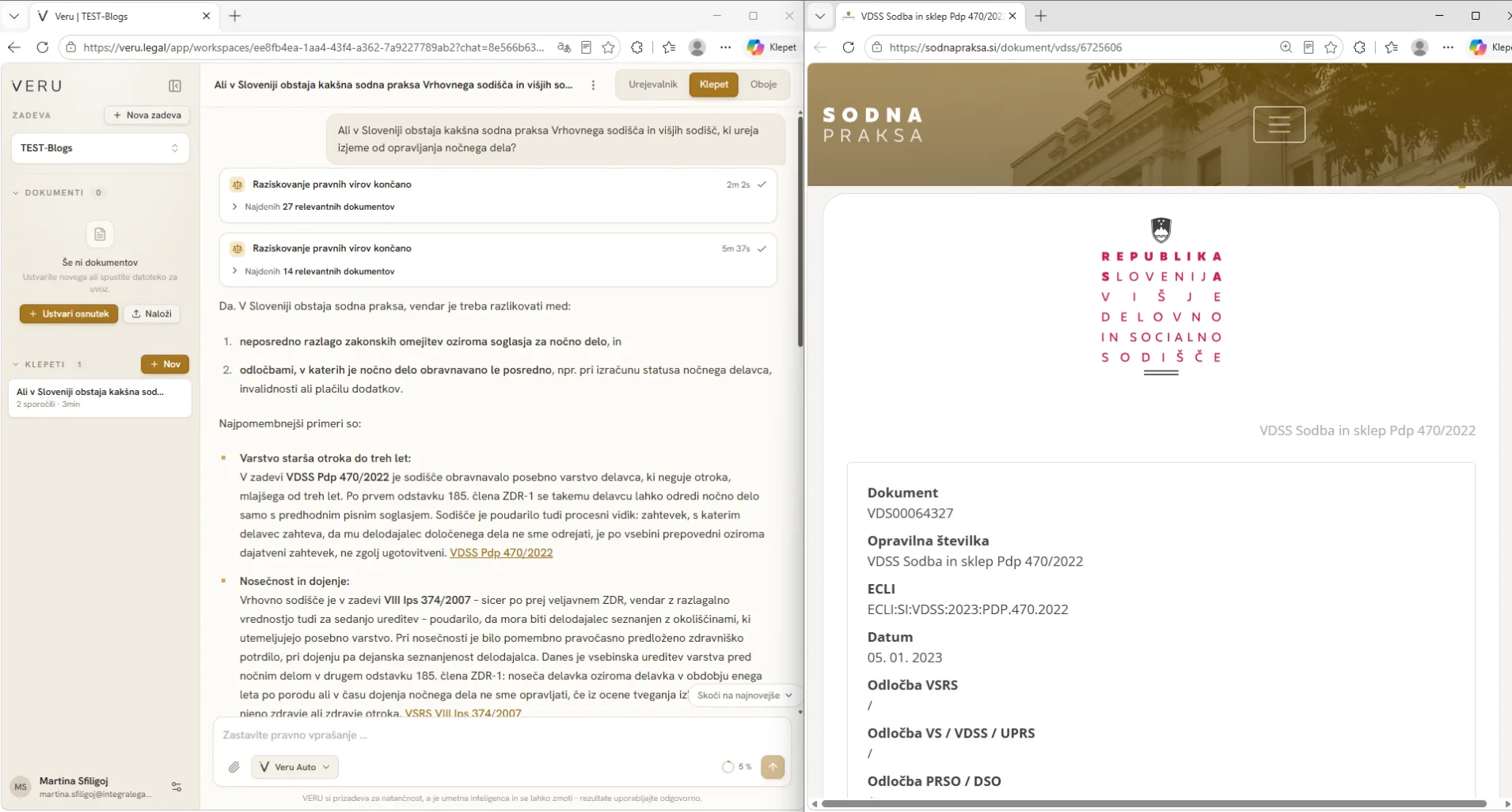
Case context instead of a blank window (myth 5): Work in Veru takes place in structured workspaces for each individual case. Documents, prior communication, and findings stay within the context, so the question doesn't need to be re-explained from scratch every time.
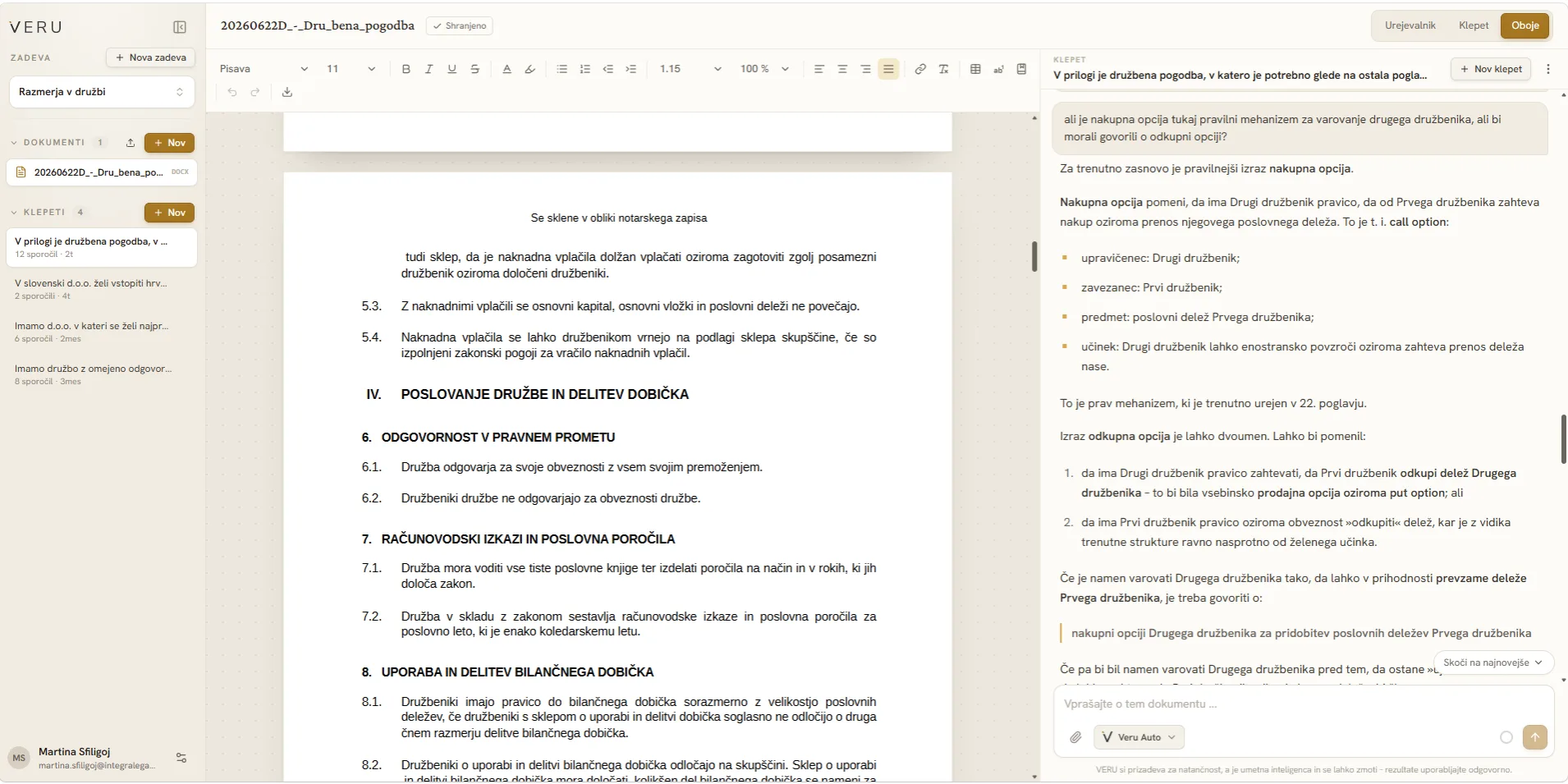
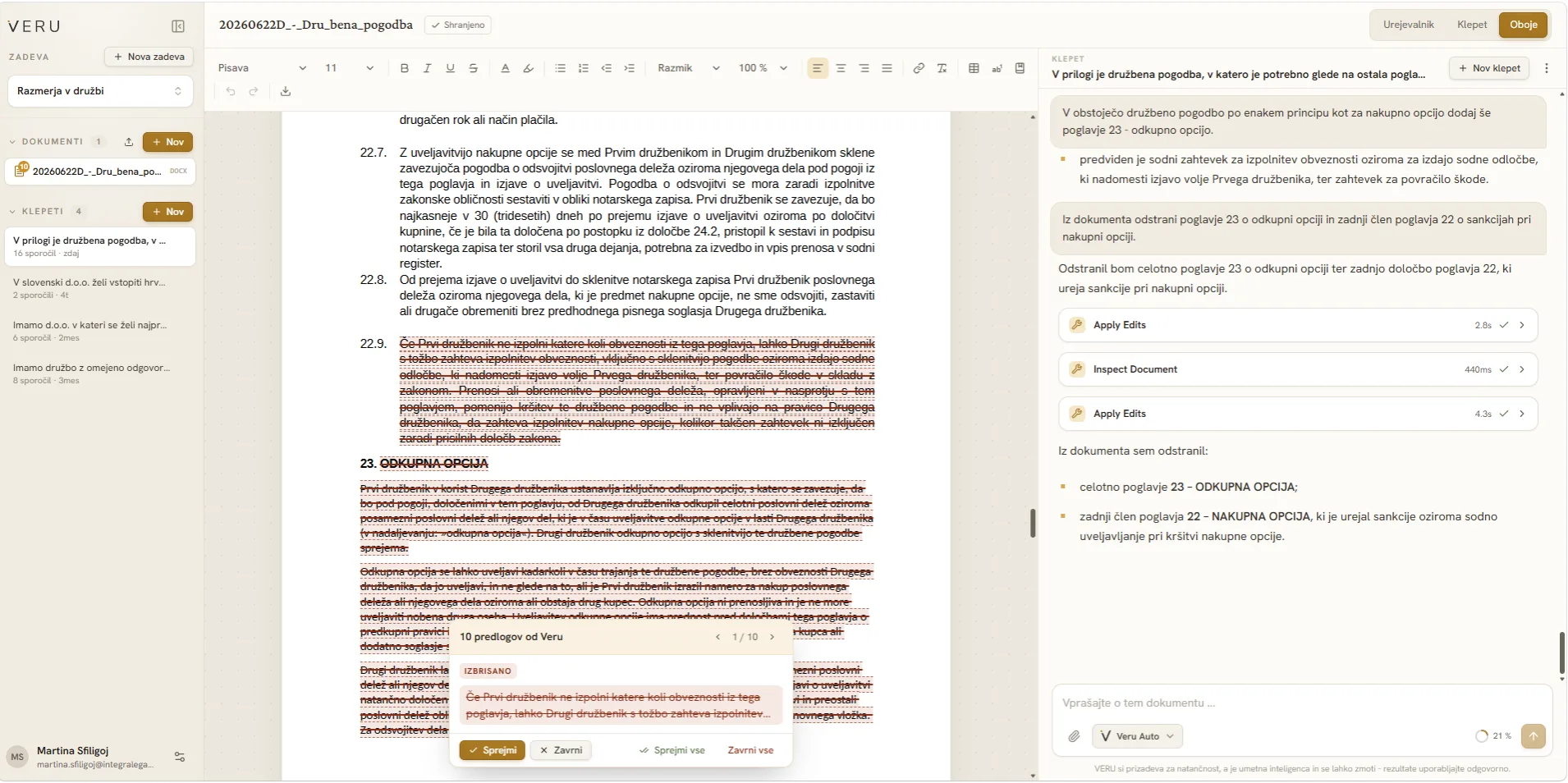
The draft comes together right where you edit the document (myths 4 and 6): Veru includes a legal document editor, so the draft doesn't need to be moved between a chatbot, Word, and email. The lawyer takes over the work at the point where it's worth the most — in judgment, revisions, and deciding what goes to the client for signature.
Organized handling of confidential data (myth 3): User inputs and documents are not used to train or improve models; processing is limited to providing the service, and the provider treats documents and communications as confidential.
Some concerns, however, are not myths and remain: responsibility for every claim still rests with the lawyer, source verification is still mandatory, and judgment cannot be automated. This is not an obstacle to using artificial intelligence — it's a description of how to use it correctly.