Published July 21, 2026
How Veru backs every claim with a legal source
In law, an answer without a source is just an opinion. A worked example in software copyright shows how Veru ties every claim to a cited, linkable legal source.
General-purpose AI tools can produce a legal answer that sounds convincing at first glance. The problem is that a legal professional often can't verify where that answer came from — and in law, an answer without a source is just an opinion.
Veru works differently: every claim comes attached to a cited source — a statutory article with a direct link to the original text in official legal databases. A legal professional can check every step of the reasoning before relying on it.
Here's what that looks like in practice, in a case involving the transfer of economic copyright in software code created within an employment relationship.
Starting point
A software company (d.o.o.) is preparing to license its product. During due diligence, a question comes up: who actually owns the code written by an employed developer?
A legal professional gives Veru the context and asks: "Who holds the economic copyright in this code? Does the transfer of rights need to be separately addressed in the employment contract?"
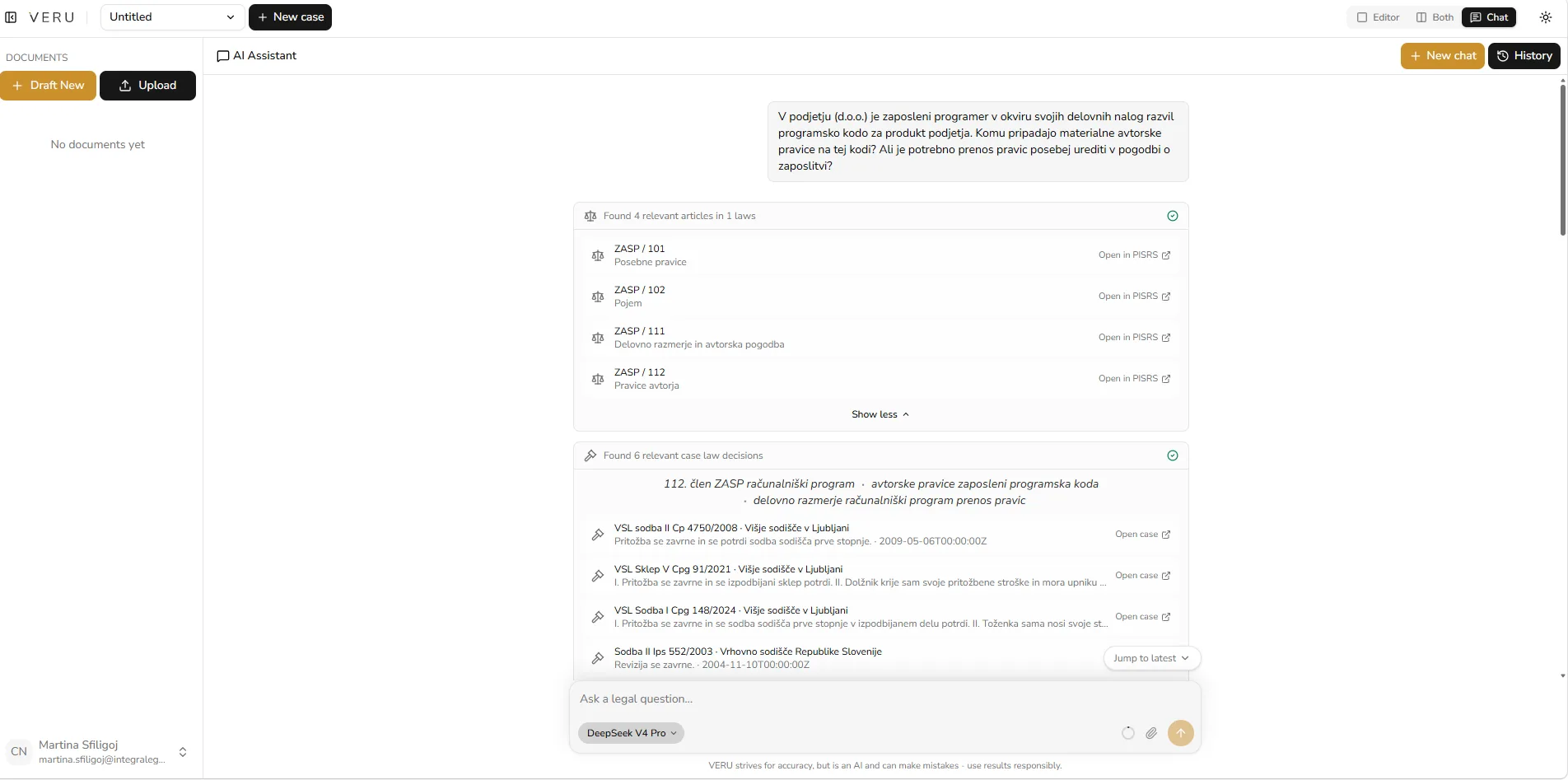
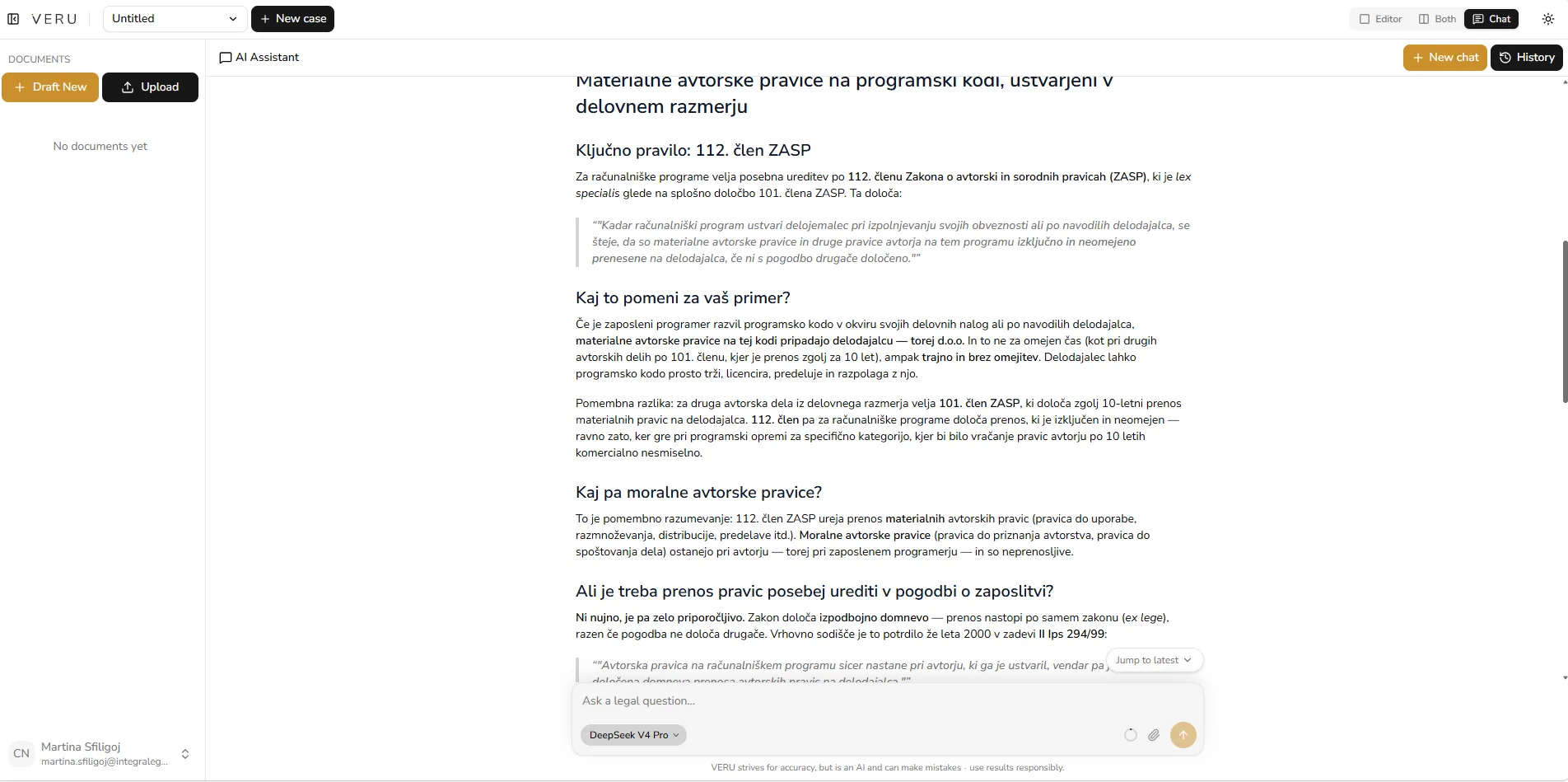
Veru recognizes that this falls under the Copyright and Related Rights Act (ZASP), not the Employment Relationships Act (ZDR-1), as it might seem at first glance:
-
The general rule. Article 101 of the ZASP governs copyrighted works created within an employment relationship: economic copyright transfers to the employer — but only for 10 years, after which it reverts to the author.
-
The special rule (lex specialis). For computer programs, Article 112 of the ZASP sets out a different regime: when a program is created by an employee in the course of fulfilling their duties or on the employer's instructions, the economic copyright is deemed to be transferred to the employer exclusively and without limitation, unless otherwise agreed by contract.
-
Confirmation in case law. Veru doesn't treat the statutory presumption as self-evident — it looks for decisions that confirm it: the Supreme Court upheld the presumption of transfer to the employer as early as case II Ips 294/99, and in case II Ips 552/2003 emphasized that a different arrangement is a matter of contractual freedom between the parties.
Each of these steps in the answer is backed by a citation and a link to the original source.
The bigger picture: where do technical documentation, specifications, and user manuals fit in?
A legal professional follows up: "Does the same apply to the technical documentation, specifications, and user manuals prepared by the same developer?"
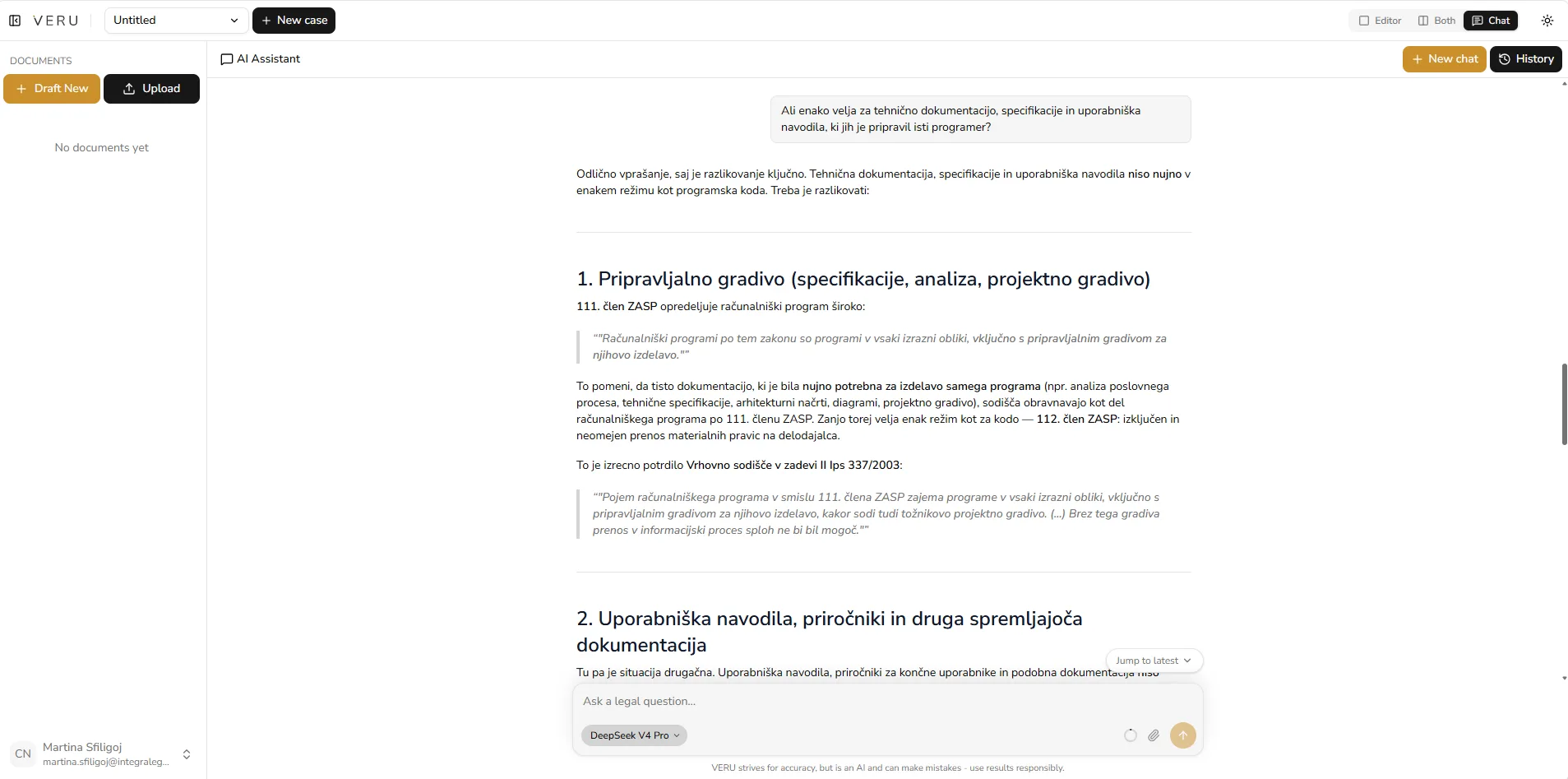
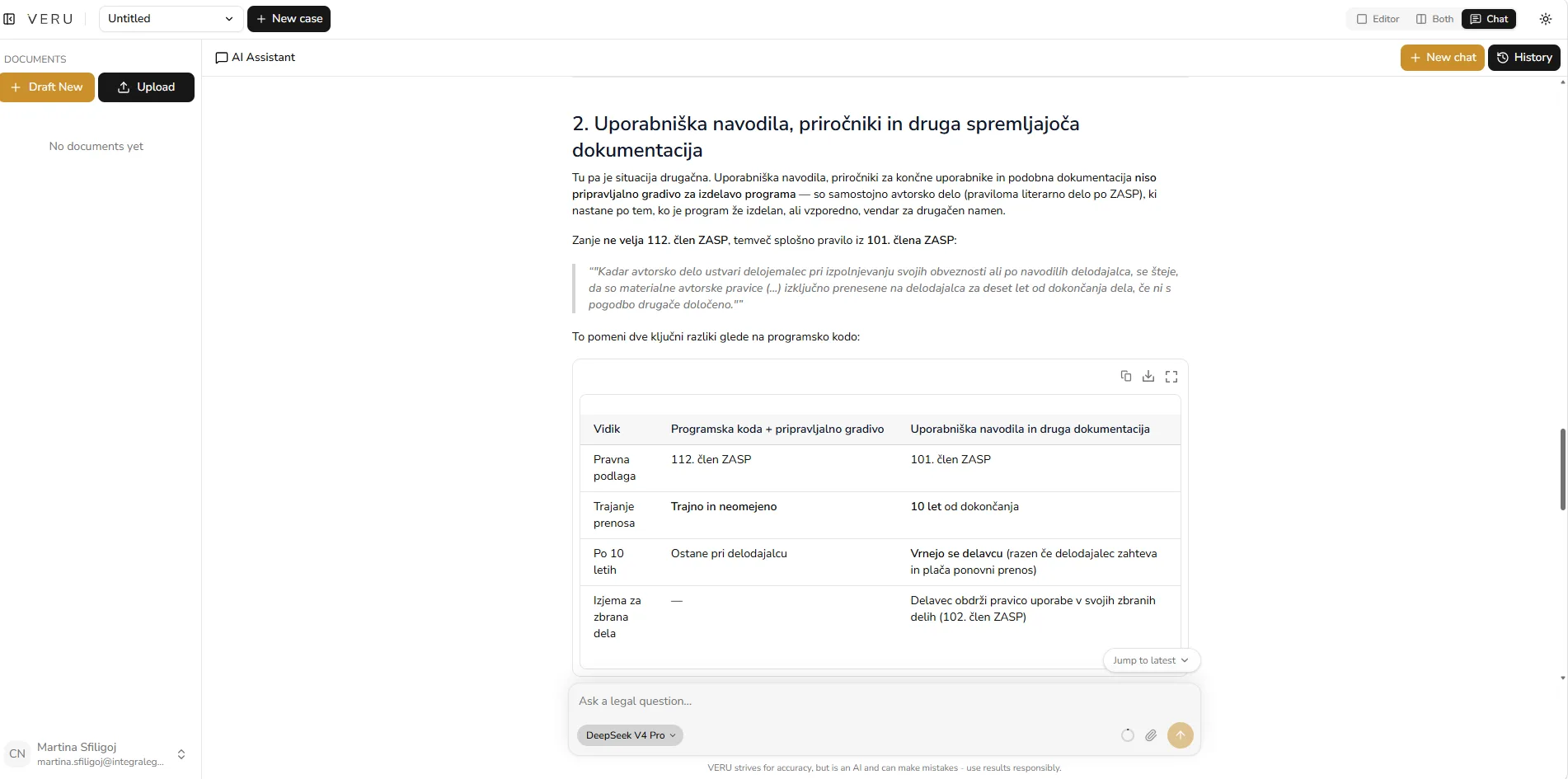
This is where the real value of traceability shows. Veru doesn't generalize — it draws a distinction between categories of material, citing a separate legal basis for each:
-
Preparatory materials (requirements analyses, architectural designs, technical specifications) count as part of the computer program under Article 111 of the ZASP, and so fall under the same regime as the code itself — a permanent, unlimited transfer under Article 112. Veru backs up this distinction with decision VSRS II Ips 337/2003, in which the court also classified project materials as falling within the concept of a computer program.
-
User manuals and guides, on the other hand, are a separate copyrighted work — for these, Veru cites the general rule under Article 101 of the ZASP: the transfer to the employer lasts only 10 years from completion, after which the economic rights revert to the employee.
A legal professional raises a third question: "Part of the code was written by the developer at home, outside working hours, on his own equipment, but it's functionally connected to the company's product. Does that part also belong to the company?"
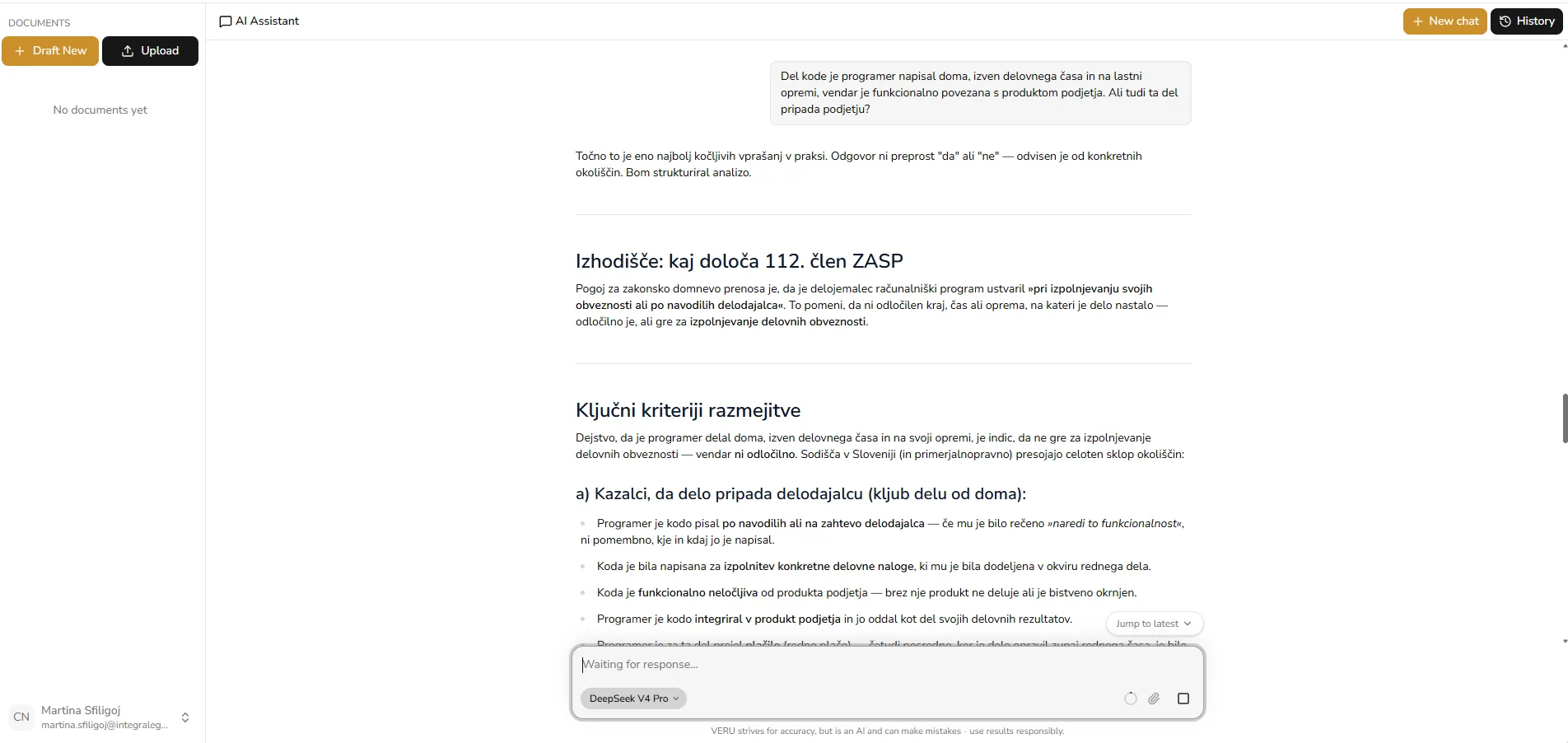
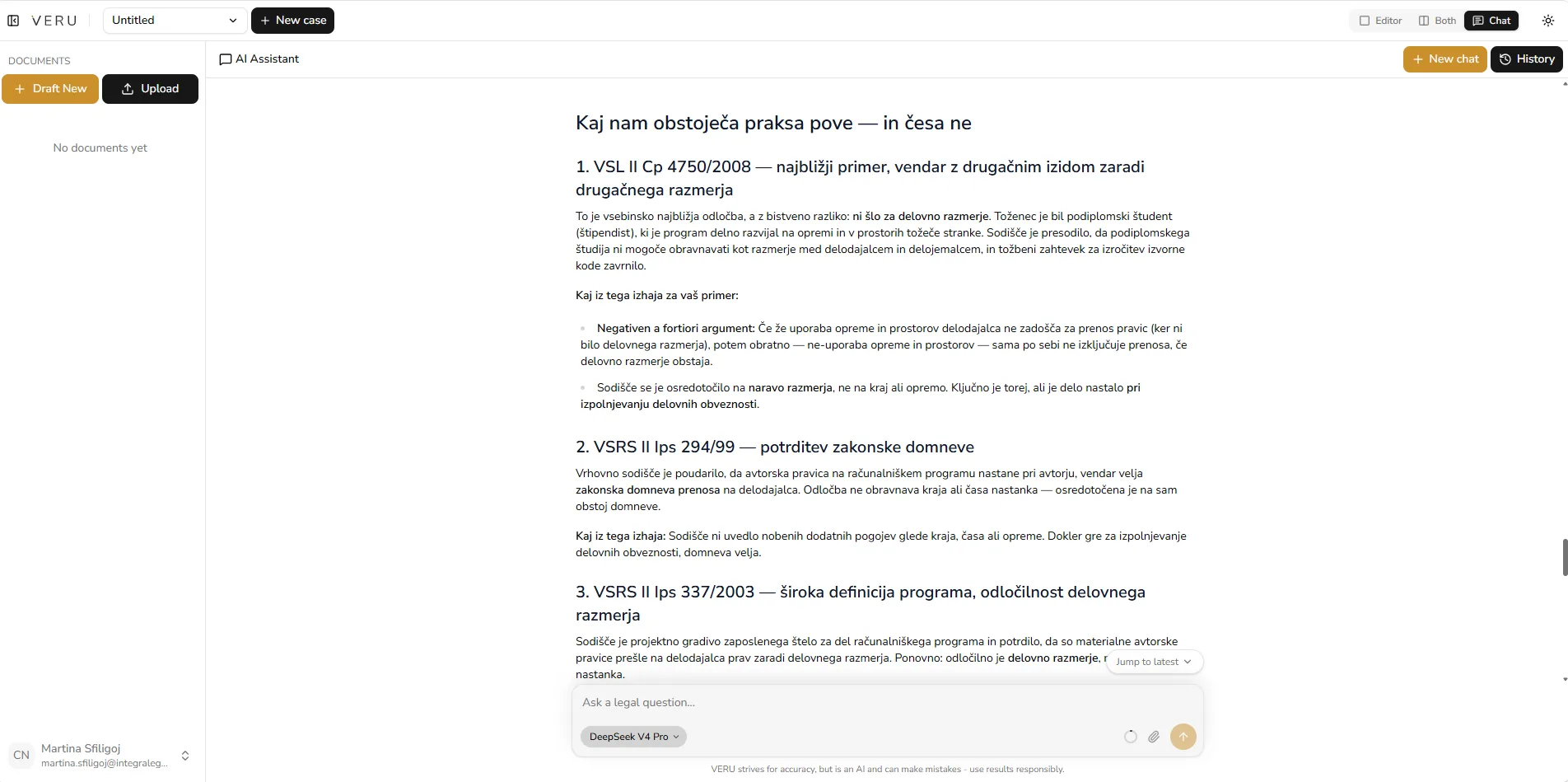
The statutory text doesn't give a clear-cut answer here, so Veru turns to case law and works out the distinction from several decisions: VSL II Cp 4750/2008 establishes that the use of equipment and premises is not, by itself, decisive, while VSRS II Ips 294/99 establishes that the presumption of transfer carries no additional conditions as to place or time — what matters is the substantive connection to the employee's work duties.
When asked directly about case law, Veru states that no decision addressing this exact scenario exists in Slovenia, and that this falls into a legal gray area. Rather than inventing a source, it cites five decisions that shed light on different aspects of the question, explaining for each what it does and doesn't establish.
That's traceability in its full sense: not only is every source cited and verifiable — when no source exists, Veru says so and finds the closest available approximation.
Why traceability matters
A legal answer is only as good as its sources. Across these three questions, Veru cited multiple articles of the ZASP and a series of court decisions — each citation linked to PISRS or another official legal database, verifiable by a legal professional with a single click. And where no case law exists, it says so clearly.
Traceability, then, isn't an add-on to the answer. It's the reason you can trust it.