Published September 9, 2026 · by Anže Skodlar
Why general AI isn't legal AI — ChatGPT, Claude, and Veru: four differences a lawyer will notice
General-purpose language models often get the answer right. The real question is how much work is left for the lawyer once the answer comes back — and that's where AI built for law differs.
Bring up artificial intelligence with lawyers, and sooner or later the same question comes up: why pay for a specialized tool when ChatGPT answers for free — and often gets it right? It's a fair question, and it deserves a real answer, not just the claim that general-purpose models get things wrong. Because often they don't. Anyone who uses them regularly knows that, and will spot exaggeration in either direction right away.
The real answer lies elsewhere. It's not about which tool "knows" more — it's about how much work is left for the lawyer once the answer comes back.
Where the answer comes from
A general-purpose language model (LLM) doesn't look up an answer — it generates one, assembling the most statistically likely continuation of your question from the vast amount of text it was trained on.
That design is remarkably good at writing, summarizing, and organizing thoughts. But in law, the "most likely" text and the currently applicable rule are not the same thing. Slovenian law is only a marginal presence in most training data — it's a small legal corpus in a small language. This barely matters for the foundational statutes: the Employment Relationships Act (ZDR-1), the Code of Obligations (OZ), or the Companies Act (ZGD-1) are covered so extensively online that a model tends to handle them reasonably well. But the moment a question moves to a specific set of rules, a decree, or a fee schedule — exactly the kind of granular material lawyers need most in practice — that footing disappears fast.
Then there's the timing problem. A general AI model doesn't work from a consolidated text and has no way of knowing which amendment is the most recent. The text it learned from isn't dated, so questions about when a provision took its current form simply don't play to its strengths. Even when the model searches the web, the problem doesn't go away — it just relocates, since the most accessible results tend to be portal summaries, older Q&A threads, and pages that were never updated after the law changed.
Veru is built the opposite way. It pulls legislation from official regulatory registers in their current consolidated version, case law from the public database of Slovenian court decisions, and EU law in its latest consolidated form. The answer isn't reconstructed from the model's memory — it's built from a source that was actually retrieved.
That same distinction produces something lawyers pick up on immediately: ask a general AI model the same question in three separate conversations, and you can get three different answers — different in scope, in emphasis, sometimes even in which provisions get cited. That's simply how the technology works. But for legal work, the rule is straightforward: an answer that isn't reproducible isn't reliable, even when it happens to be correct.
Why "correct" still isn't good enough
Say the general model's answer is, in fact, correct. The next question is: how would you know?
To find out, you still have to pull up the statute and check the provision yourself — in other words, do the exact work the tool was supposed to save you. An answer you have to independently verify hasn't actually saved you any time.
Nowhere is this clearer than with case law. It's not a matter of getting lucky on a particular question — it's a structural gap: Slovenian court decisions are practically absent from general models' training data. So the answer tends to land in one of two places. Either you get a generic explanation with no case citation — not necessarily wrong on the merits, but useless for a filing — or you get a citation to a case that doesn't actually exist. The second scenario is the more dangerous one, because the answer looks complete.
Veru backs every citation with a source and a link to the underlying document, so verification is one click away. When there's no relevant case law, Veru says so outright. A general model will almost always produce something, because that's what it's built to do. For a lawyer, though, knowing that no settled practice exists on a given point is itself useful — often useful enough to change strategy.
A tool that remembers the conversation vs. a tool that knows the case
A general-purpose chatbot remembers your conversation. It doesn't know your case. The difference only becomes obvious over time.
You can upload documents to a general AI tool and get a decent first pass at analysis. But once you close that conversation, the context is gone. A week later, when the client sends over a new piece of evidence, you're re-explaining the case from scratch. Document versions aren't tracked, so down the line you can't say with confidence which draft of the contract a given assessment was actually based on. On one file, that's an annoyance. Across thirty, that's how errors creep in.
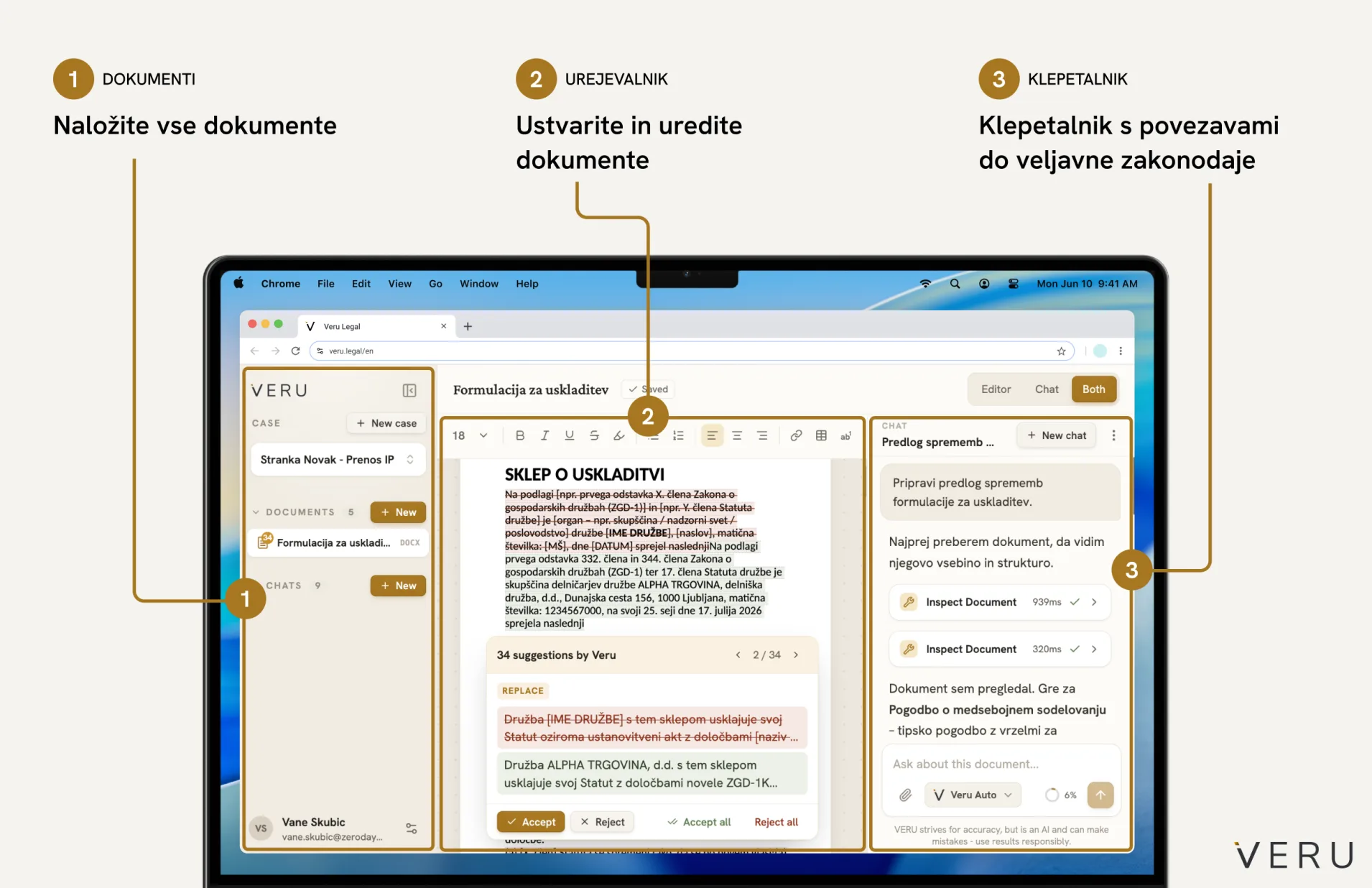
In Veru, every matter lives in its own workspace. Documents, analysis, and prior questions stay together, so each new question builds on context the system already has. On top of the case files themselves, you can add your firm's own context too — standard clauses, internal policy, established practice.
That's what makes the next step possible — arguably the step that matters most in legal work. Veru doesn't just find the relevant law; it applies it to the facts in front of it and answers by pointing to the specific provisions in your own documents, not a generic rule. That's the line between retrieving information and actually reasoning through a legal problem.
The last step people tend to overlook
Legal work doesn't end with an answer. It ends with a document.
In a general AI tool, you get text in a chat window — and then the familiar routine kicks in: copy into Word, format it, revise it, go back to the chat with a follow-up question, copy again. Every one of those handoffs is a place where the latest version can get lost, or where a claim survives in the document after the reasoning behind it has quietly changed.
In Veru, the draft is written in an editor inside the same matter. Edits happen there, sources stay attached to the text, and the document remains linked back to the material it was built from.
So what should you actually choose
A general model generates the most probable answer from a massive body of text, and for run-of-the-mill legal questions, it will often get there. But "often right" and "something you can rely on" aren't the same standard in law. The gap between the two doesn't show up when you check the answer — it shows up the one time you don't.
Veru is built to construct answers from official legal sources, back each one with a citation and a link, preserve the full context of the matter, and let a document emerge directly from the analysis — all in one place.
A general AI model tells you what's written on a topic. Veru helps you resolve your actual case, with sources you can verify, in an environment built specifically for legal work.