Published July 21, 2026
One matter, one workspace: from contract review to new document
Review a contract, redline it, and draft a new document — all in one workspace, with context carried across every step.
Legal work is rarely a single task. A typical matter usually means: reviewing documents, checking the law, making edits, drafting new documents. In practice, this also tends to mean: a PDF in one window, a statute in the browser, edits in Word, a draft in yet another tool — and manually shuttling content between all of them.
Veru brings these steps together in one workspace. Documents, analysis, and drafts all live in the same place, and Veru holds onto context across the whole matter. What it finds during review carries over into the edits, and into every document that comes after.
Here's what that looks like in practice.
Starting point: a contract with an outside developer
A company in digital logistics management hires an outside contractor to develop software. The engagement is meant to be governed by an existing "Business Cooperation Agreement" — a framework contract the company has used for years. Before signing it with the new contractor, a legal professional uploads it to a Veru workspace and asks:
"Attached is our standard contract with external contractors for software development. Check whether it complies with the law and whether anything essential needs to be added or changed."
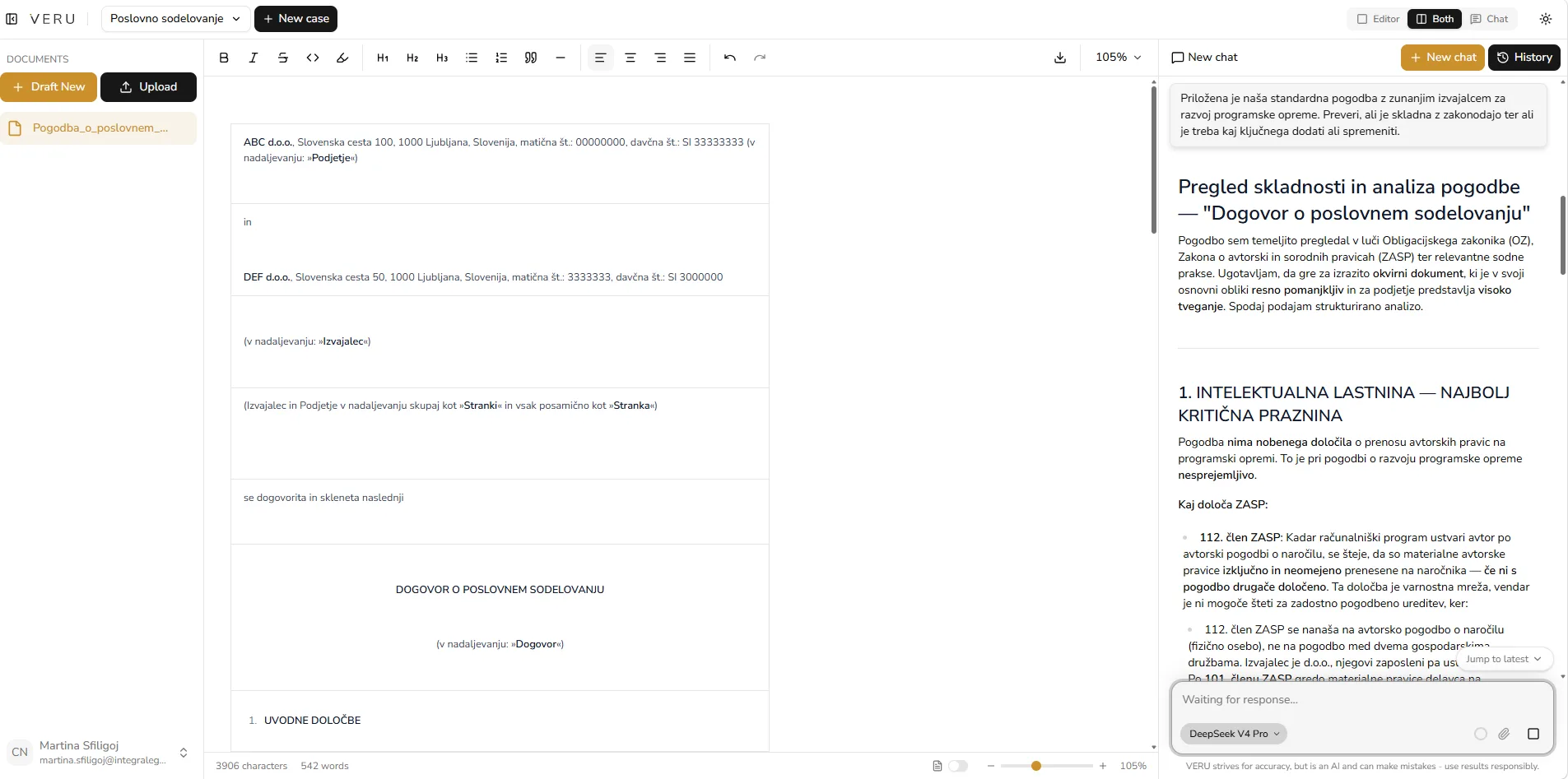
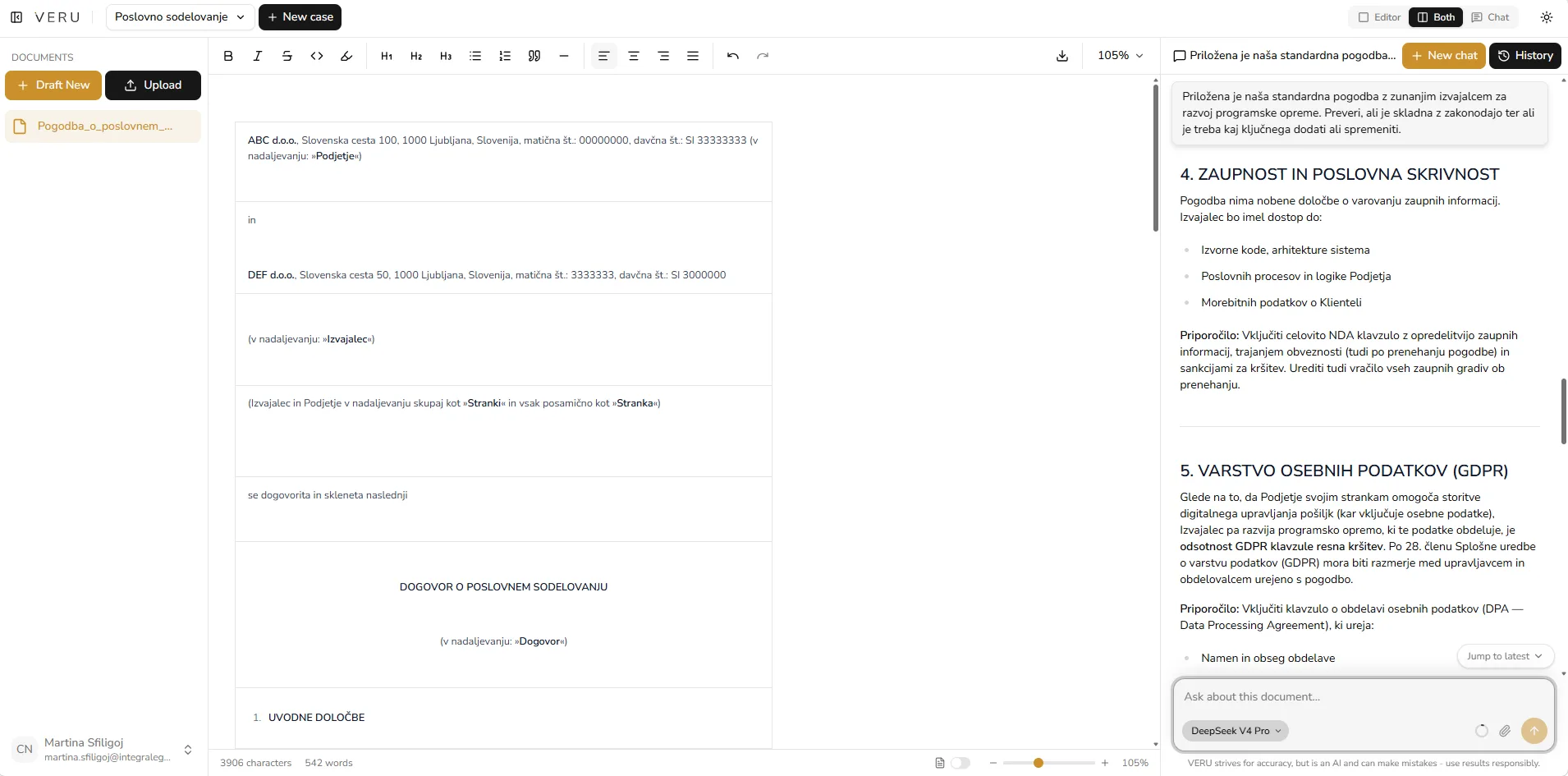
Veru reviews the contract against the relevant law and case law and returns a structured breakdown of the gaps. Among other things, it finds that the contract has no provisions on intellectual property in the software, protection of confidential information, or personal data protection.
All of this happens right there in the workspace, alongside the uploaded document — no copying the contract into a chat window, no manually digging through statutes.
Edits made directly in the contract
A legal professional follows up: "Add the missing intellectual property chapter directly into the contract."
Instead of generating new text in a reply that then has to be copied over into Word by hand, Veru inserts a new intellectual property chapter directly into the contract, in the right place within the document's structure. Because the findings from the review stay part of the matter's context, Veru doesn't need to be told again what's missing or why.
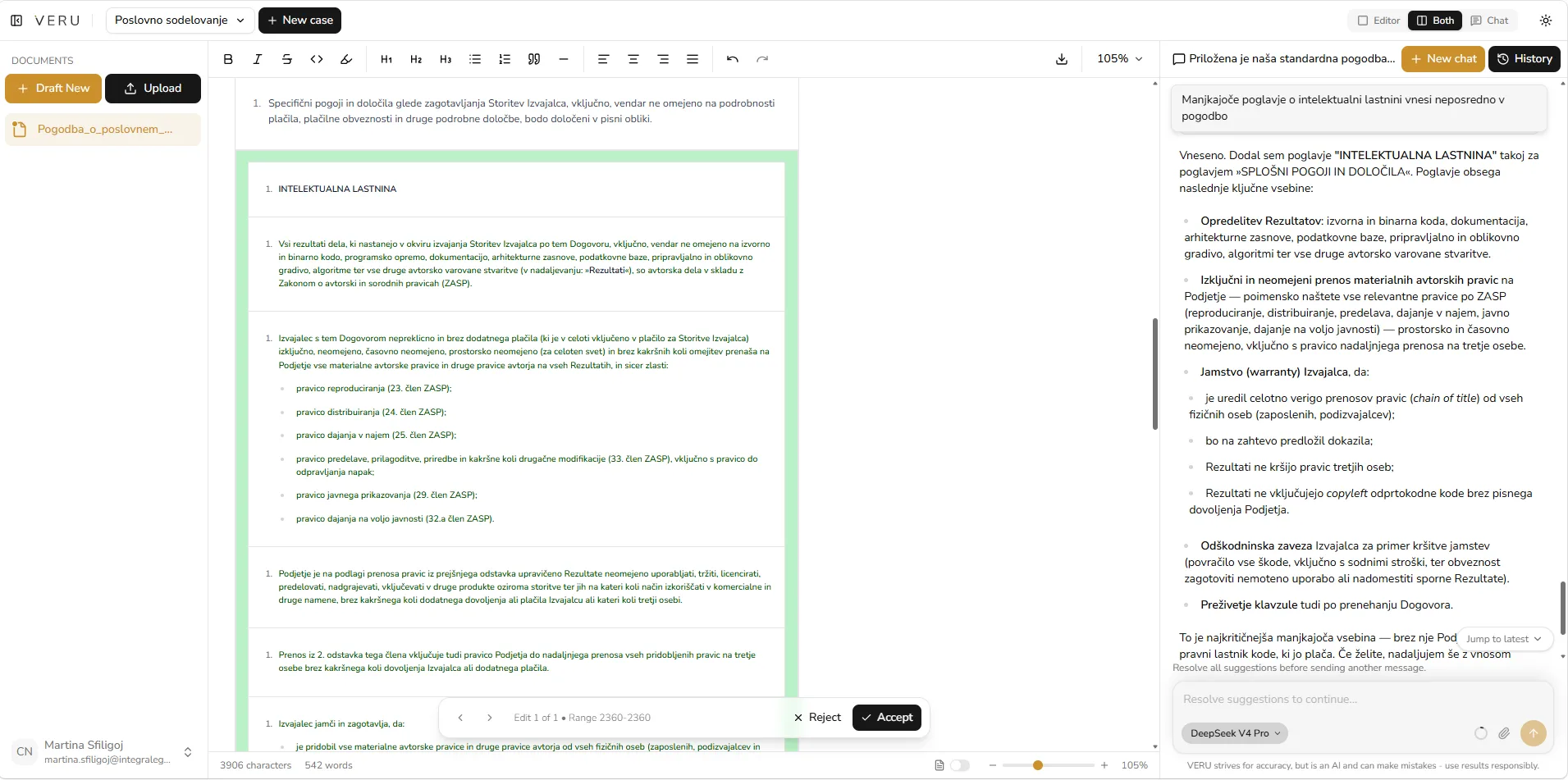
All the changes appear as tracked changes: a legal professional can review them, accept or reject them, and edit the text directly in the editor as well. Final control over the content stays with the legal professional.
A new document
Since Veru had flagged that the contract didn't cover protection of confidential information, a legal professional gives a further instruction:
"Based on this business cooperation agreement, create a non-disclosure agreement (NDA) for the same parties, as Annex 1 to the contract."
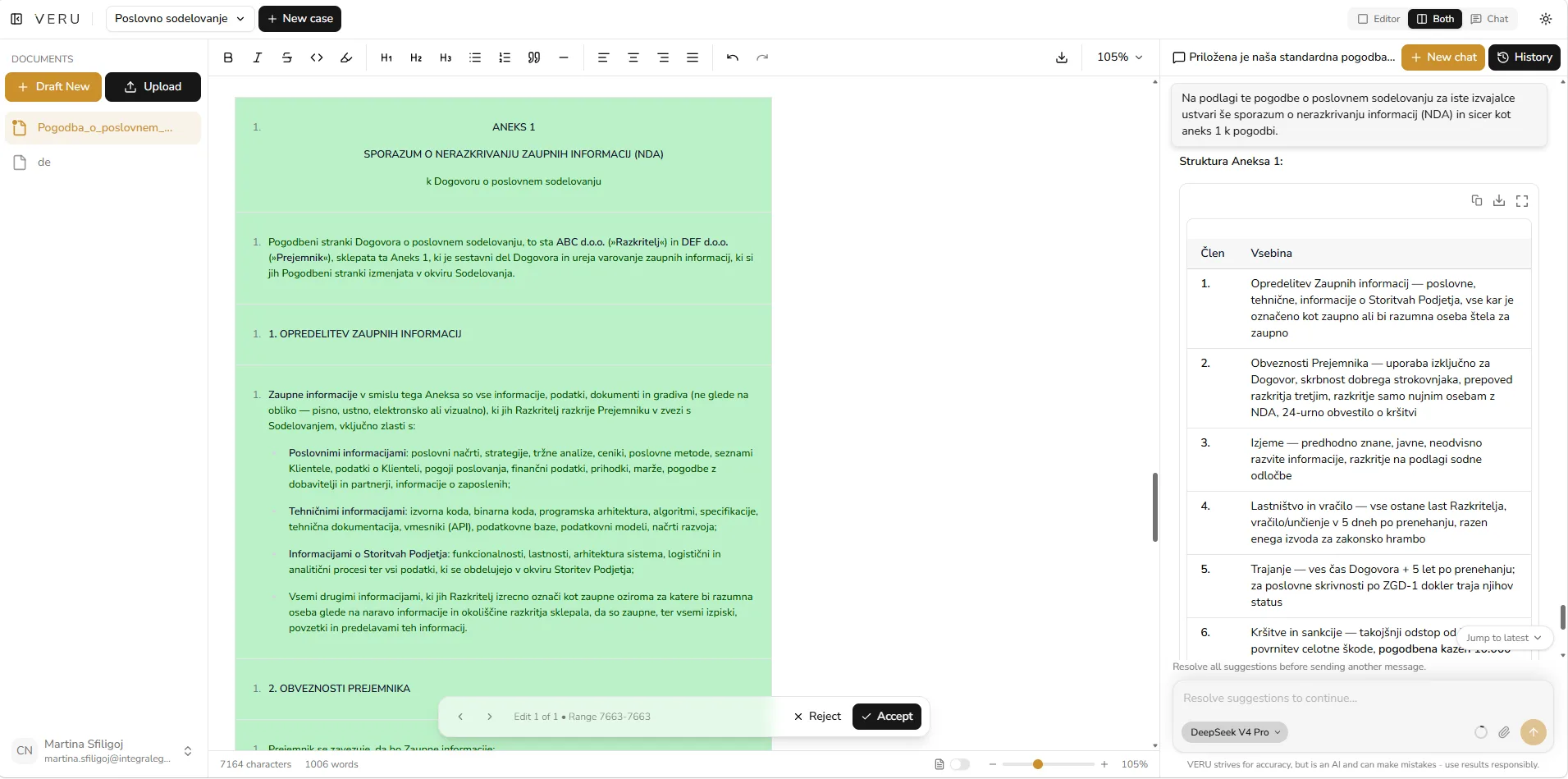
Veru already knows who the parties are, what the engagement covers, and what the contractor will have access to — all of that was established during the review in step one. It inserts Annex 1 directly into the document, after the signature block of the main agreement, and drafts it as a full NDA: covering the definition of confidential information, the recipient's obligations, exceptions, the duration of obligations after the contract ends, and penalties for breach, including a contractual penalty clause.
A document that would normally be built from a template in a fresh Word window — with the parties, definitions, and risks all adjusted by hand — instead comes together in the same workspace, aligned with the contract it belongs to.
One matter, one workspace
Three steps — reviewing the contract, adding the missing chapter, drafting a new document — that would normally play out across different tools instead happened in a single workspace. And because Veru holds onto context throughout the matter, each step built on the one before it: the edits drew on the review's findings, and the NDA drew on what Veru already knew about the parties and the risks.
Less switching back and forth, less manual copying, fewer chances for error — and more time for the actual legal work.