Published July 21, 2026
How Veru understands the law
Veru doesn't just find the law — it applies it to the situation in front of you. A worked example: transferring a business share in a three-shareholder d.o.o.
Legal questions rarely come neatly labeled with the statute that applies. They show up as real situations — a client, a backstory, competing interests that need to be balanced. That's where Veru adds real value: it doesn't just track down the relevant law, it knows how to apply that law to the specific case at hand, spot the questions that actually matter, and think about the bigger picture — the way an experienced legal professional would.
Corporate transactions are a great illustration of this. Transferring a business share in a limited liability company (d.o.o.) looks, on the surface, like a routine formality. In reality, it involves a string of decisions with long-term consequences for the relationships between shareholders.
Case in point: transferring a business share in a three-shareholder d.o.o.
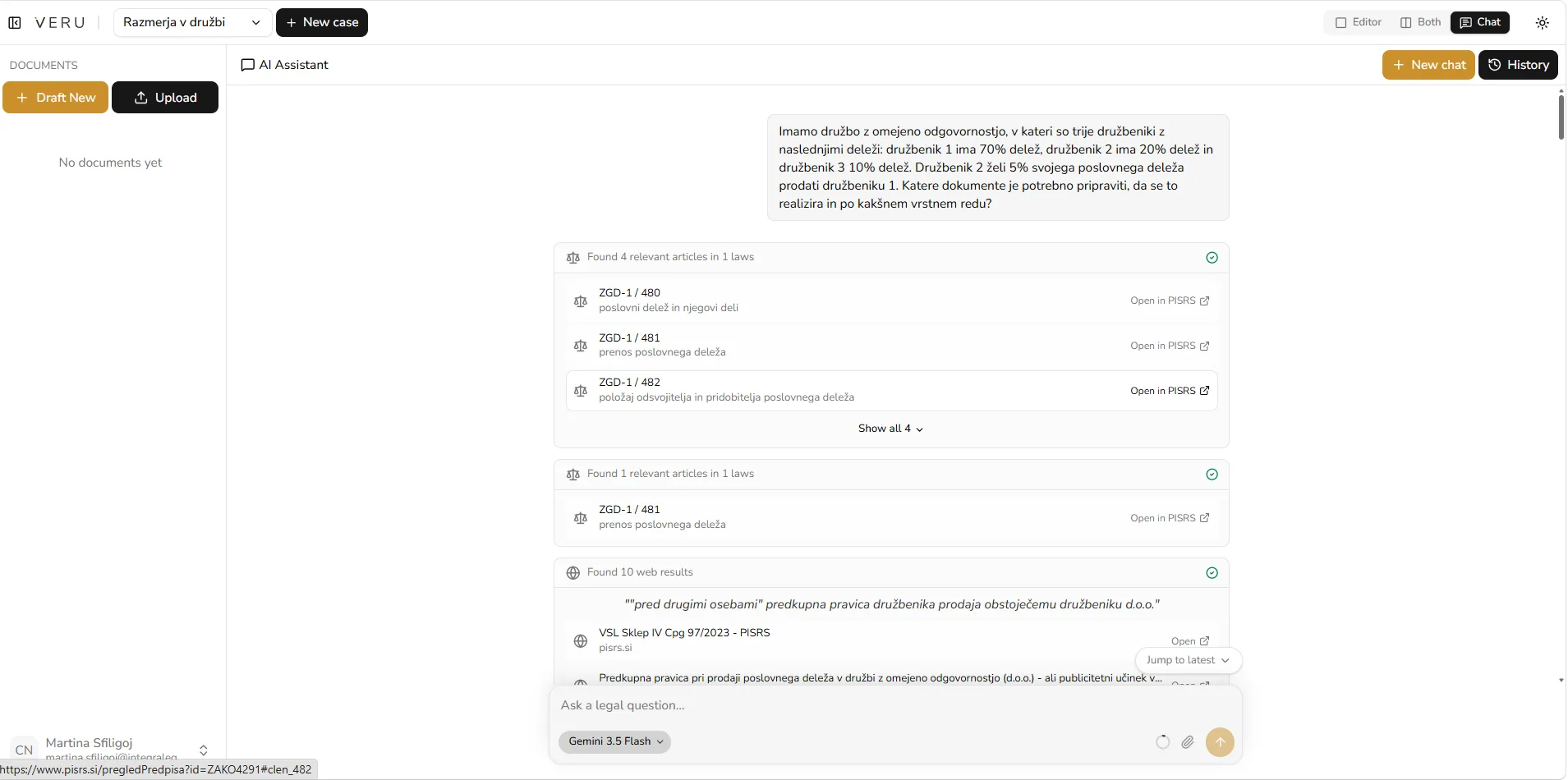
Starting position: Shareholder 1 owns 70%, Shareholder 2 owns 20%, and Shareholder 3 owns 10%. Shareholder 2 wants to sell 5% of their share to Shareholder 1.
A legal professional asks Veru: "What documents do we need, and in what order?"
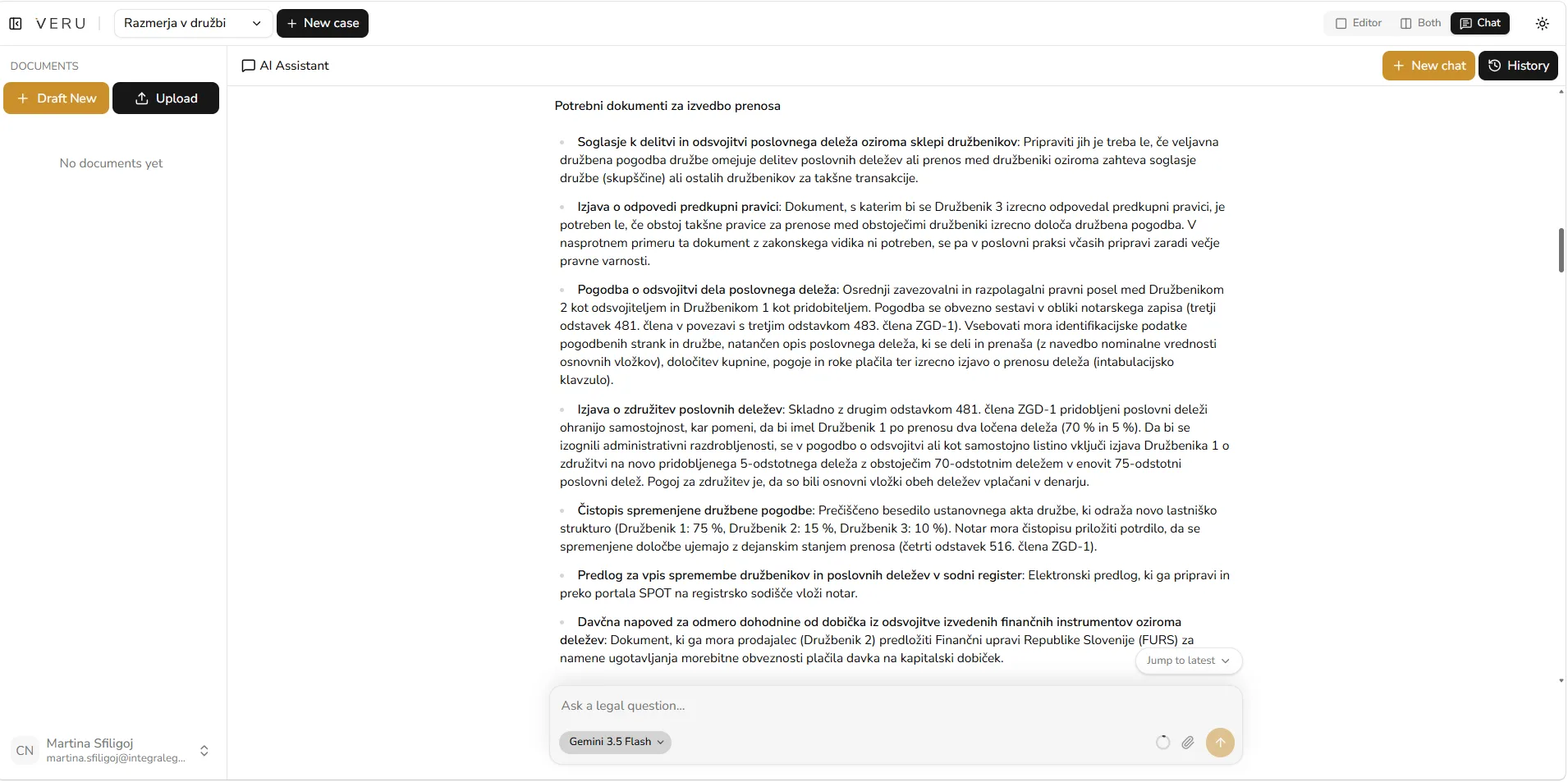
Veru doesn't just spit out a list of statute numbers. It pulls in the relevant law — Articles 480, 481, and 482 of the Companies Act (ZGD-1) — along with the relevant case law, then works through the answer the way a legal professional would reason it out.
First, it flags something easy to miss: you need to check whether the articles of association restrict the transfer or require consent. Only once that's settled can you determine whether Shareholder 3 needs to formally waive their pre-emption right — and whether that's actually required, or just good practice for legal certainty.
From there, it lays out the paperwork in the order it needs to happen: a share transfer agreement executed as a notarial deed (Art. 481(3) ZGD-1), a clean, notarized copy of the amended articles of association (Art. 516(4) ZGD-1), registration with the court register, and a possible tax filing by the seller with FURS.
Zooming out: what does this transfer mean for the company itself?
Once the paperwork is sorted, a new question comes up: how does the new ownership structure affect voting rights?
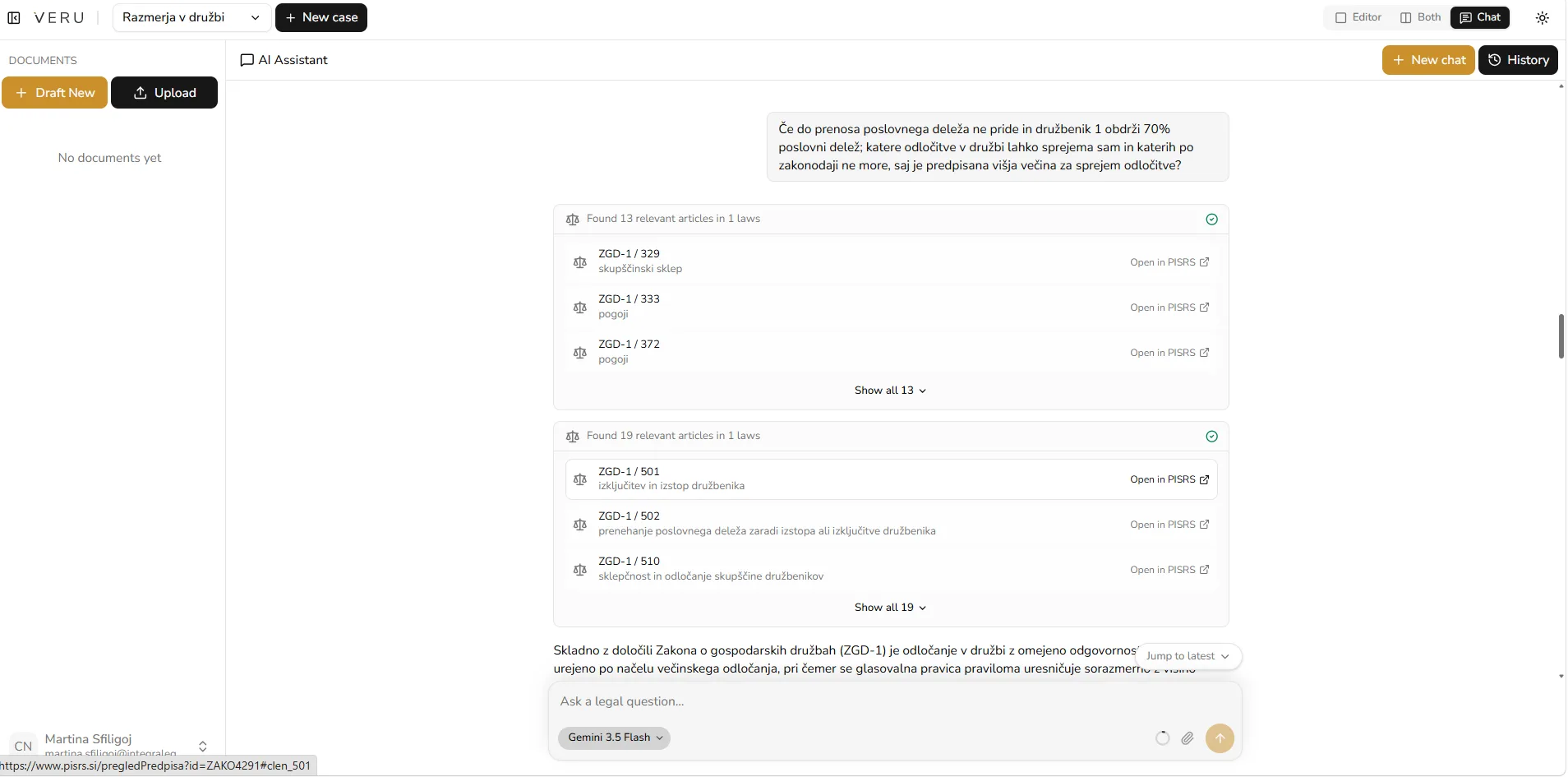
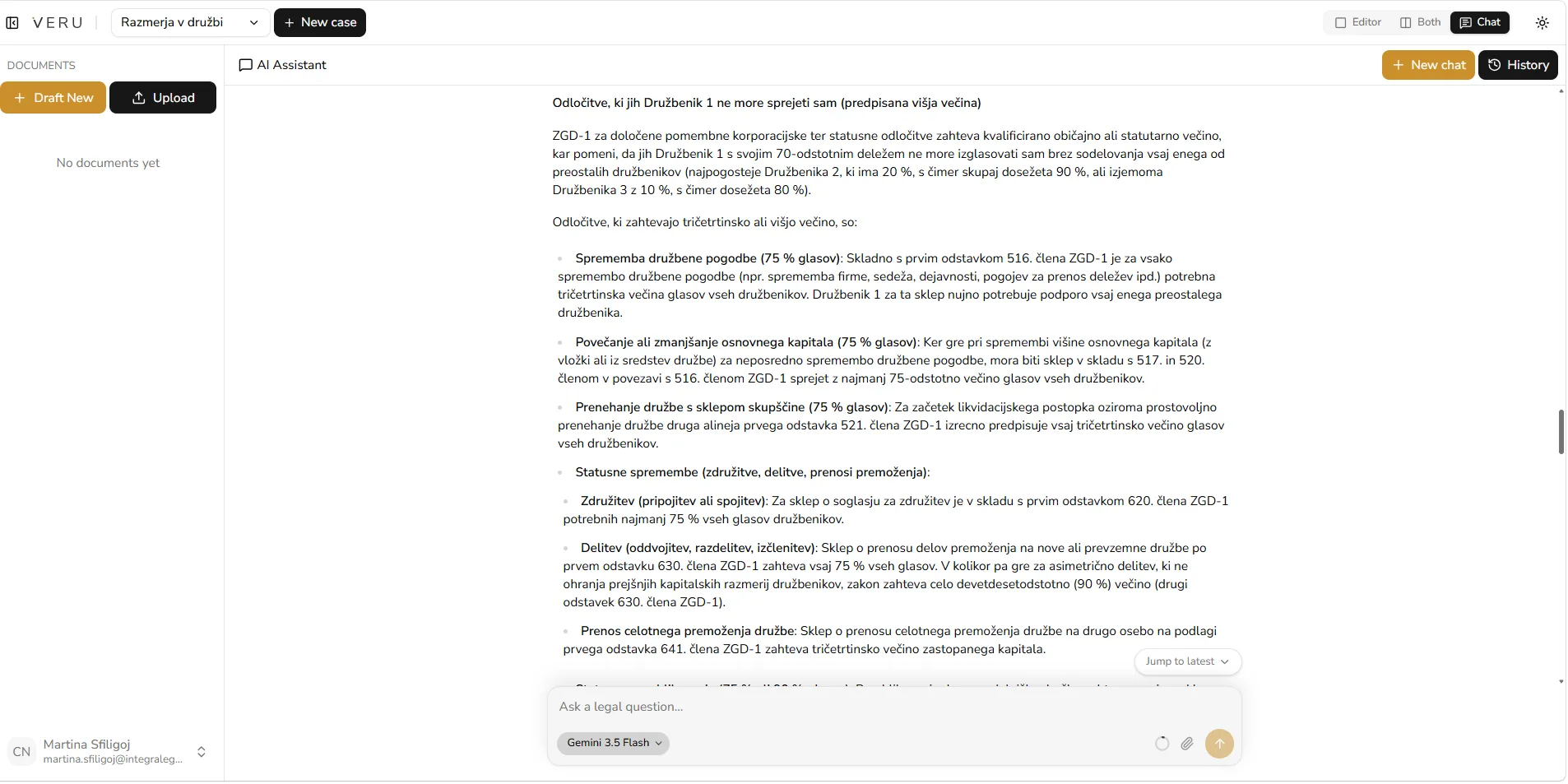
After the transfer, Shareholder 1 holds 75% overall. Veru immediately puts that number in context: this is the first threshold where Shareholder 1 can vote through amendments to the articles of association, changes to share capital, and voluntary dissolution of the company on their own — none of which was possible at 70%.
But it also flags where the limit still stands: under certain provisions of the ZGD-1, a qualified majority is calculated against all votes in the company, not just the capital actually represented — meaning 75% still isn't enough for some corporate decisions.
That's not just a detail for the client's benefit. It's exactly the kind of thing a legal professional needs to know to advise well.
The bigger picture
This example shows what separates strong legal advice from average advice: it's not just answering the question you were asked, but understanding what that answer actually means in context. When a legal professional asks the right question, Veru doesn't apply the law mechanically — it connects it to the full picture. And that's what actually matters in practice.